Technology
How to Search Inside a Video (YouTube, iPhone, Google & More)
Videos are everywhere, but finding one specific moment inside them is painful. This complete guide explains how to search inside a video — from YouTube transcript tricks and iPhone limitations to AI-powered search, context-aware detection, and why converting spoken content into searchable text is the smartest fix.
How to Search Inside a Video (Complete Guide)
Videos are everywhere — YouTube tutorials, online lectures, recorded meetings, podcasts, product demos.
If a video has no searchable text yet, start with YouTube video to text conversion and then search the result.
But here's the real problem:
You can search Google. You can search text. But can you search inside a video?
Most people try rewatching.
That's inefficient. And if you've ever spent hours scrubbing through footage just to find that one tiny moment — a fact dropped in a meeting, a step in a how-to, or a key quote in a lecture — you know the pain. It's tedious, frustrating, and easy to miss what you're looking for.
Even security and operations teams, who depend on fast access to the right moments, run into this wall. Digging through hours of video to pinpoint a single event (like a security incident, compliance check, or customer dispute) is slow and often comes down to guesswork. Most video tools only let you jump to rough timestamps or filter by basic text prompts like “dog” or “red shirt.” The moment you need to combine details — like “man with a blue backpack entering after 2pm” — most search features simply can't keep up.
So, whether you're a student, a professional, or just someone trying to find that one quote from a podcast, searching within videos isn't easy. And that's exactly what we're here to fix.
This guide explains exactly:
How to search inside a video
How to search for a specific word in a YouTube video
How to find a specific part of a YouTube video
Whether AI can search videos
How Google Lens and reverse search work
How to get all the words said in a video
Let's break it down clearly.
1. Can You Search Inside a YouTube Video?
Yes, but only partially.
YouTube allows transcript viewing for many videos.
How to search for a specific word in a YouTube video:
Open the video.
Click the three dots below the video.
Click “Show transcript.”
Use Ctrl+F (or Command+F on Mac).
Type the keyword.
This helps you:
Search text in video
Find a specific part of a YouTube video
Jump to timestamps
However:
Not all videos show transcripts.
You cannot search within liked videos.
You cannot search within a YouTube playlist transcript-wide.
There's no advanced search inside YouTube video audio.
So yes, you can search inside a YouTube video, but it's limited.
Most traditional video search tools don't make things much easier. They usually stop at simple filtering or basic text prompts — think “man in a red shirt” or “brown truck.” The moment you want to search for something more complicated, like several details at once, or a specific behavior over time, these tools tend to fall short.
Most search features rely on strict rules or object recognition, returning every clip with a “red shirt” or “truck,” but missing the actual scenario you care about — like a person in a red shirt entering a truck and then driving away. The real challenge isn't just finding an object, but understanding context and patterns over time.
So, while YouTube's built-in transcript search can help for simple tasks, it doesn't handle complex or layered searches within video content. For anything more advanced, you'll need a different approach.
2. How to Get All the Words Said in a Video
If you want every word spoken in a video, you need a transcript.
Options include:
YouTube auto captions (limited)
Manual transcription
AI transcription tools
Once converted to text, you can:
Search for specific words
Extract quotes
Analyze content
Use transcripts for SEO
Many professionals now store transcripts in a searchable format instead of relying on video playback.
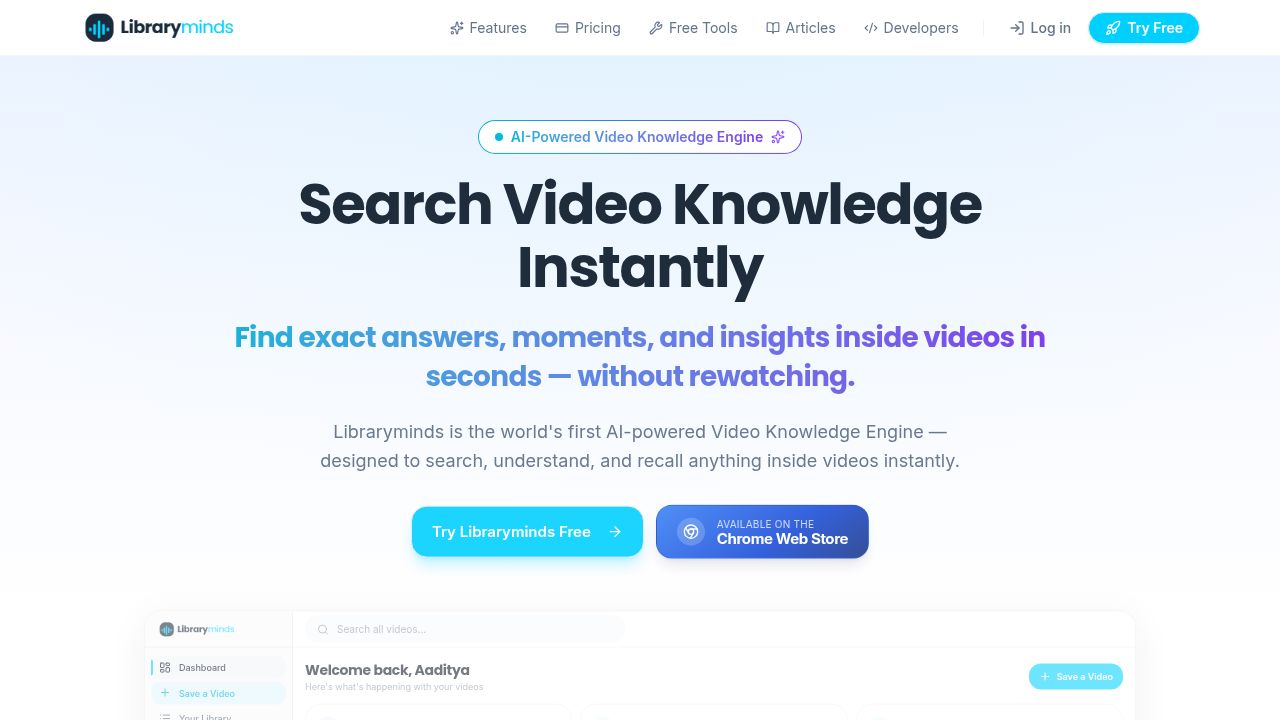
For example, transcript-based knowledge systems like Libraryminds allow users to upload videos or paste YouTube links and instantly search inside the spoken content.
This solves the “format problem” of video being linear.
3. How to Search Text in Video on iPhone
If you're wondering:
How to search through videos on iPhone?
How to search for a video on an iPhone?
Here's the reality:
You cannot directly search inside the spoken words of a video file on iPhone unless:
The video has embedded captions
Or you convert it to text first
Some iPhone apps use AI to generate captions automatically, which then become searchable.
Without text, searching inside video content is impossible.
4. Can AI Search Videos?
Yes, but only if the video is converted into structured data.
AI can:
Transcribe speech into text
Detect objects in a video
Recognize faces
Identify spoken phrases
Analyze keywords
So if you're asking:
Can AI search videos? → Yes.
How to detect an object in a video? → AI computer vision.
Can I Shazam a video clip? → Yes, for music recognition.
But AI cannot search raw video without analysis first.
Searchability requires conversion into:
Text (for speech)
Metadata (for scenes)
Objects (for visual detection)
5. What Are the Real Benefits of Advanced AI-Powered Video Search?
Let's get practical.
If you've ever spent hours skimming through security camera footage trying to answer one simple question — what actually happened? — you know the pain. Fast-forwarding, rewinding, and squinting at grainy video is no one's idea of efficiency.
Here's where modern AI-powered video search changes the game:
Find Exactly What Matters (Lightning Fast): Instead of manually watching hours of footage or relying on broad keyword tags, you can type in natural language phrases or even detailed descriptions. Searching becomes as easy as asking, “Show me every time someone enters with a red backpack,” or “Find instances of register activity with no customer at the counter.”
Reduce Human Error: AI systems that understand context spot events or risks that humans might miss in late-night review sessions. Fewer oversight gaps, fewer missed incidents.
Smarter Context, Fewer False Alarms: Unlike old-school motion alerts or basic object detection, advanced AI considers what's actually happening — so you get fewer irrelevant alerts and more actionable insights.
Actionable Insights, Not Just Clips: You're not just watching video; you're extracting data. Need to confirm if safety protocols are followed on the factory floor? Want to know who accessed a restricted area after hours? AI-driven search pulls the relevant moments instantly.
Works Across Locations & Cameras: Whether it's one office or a global network, these tools handle multiple feeds, locations, and device types seamlessly — without endless manual tagging or setup.
Enables Proactive Security and Compliance: With faster investigations, teams spend less time on reactive review and more on prevention, compliance audits, and strategic planning.
Real-World Use Cases:
Retail: Spot unusual activity, prevent theft, monitor employee compliance.
Warehouses & Industrial: Ensure hard-hat protocols, flag restricted area access, validate safety training.
Healthcare: Monitor hand hygiene, confirm pharmacy access, support audit trails.
Education & Campuses: Respond to reports quickly — whether it's locating a missing student or verifying an incident — across sprawling campuses.
6. What Makes a Leading AI Video Search Solution?
Most AI video search tools have some frustrating limits. If you've ever used a basic system, you know the drill: it only works with certain (usually expensive) cameras, it just spots objects but doesn't understand what's really going on, and it gets tripped up by anything more complicated than “find the person in the red shirt.”
Here's what actually sets apart the very best AI video search solutions — the ones miles ahead of generic or proprietary options:
Camera-Agnostic Functionality: Top solutions work with virtually any IP camera, from big names like Hikvision and Axis to budget-friendly brands and even legacy equipment. No forced upgrades.
Contextual and Behavioral Search: Instead of just saying, “That's a car,” advanced AI can flag activities (“someone left a package,” “loitering detected,” “multiple entries after hours”) — prioritizing what actually matters.
Adaptive Learning: Leading platforms use continuous learning, refining detection and search accuracy based on the specific environment or camera over time. Think of it as AI that actually gets smarter the more you use it.
Hybrid Edge + Cloud Processing: Fast, local processing for real-time results, plus the intelligence of large-scale cloud analytics (like how Google Photos recognizes your dog in every picture).
Intuitive, User-Friendly Interfaces: The best systems are simple enough for non-technical users but robust enough for IT pros — offering easy keyword search, visual timelines, and detailed filters without a dense manual.
In short: If a video search tool works with any camera, understands “who did what, when,” keeps improving, and is actually easy to use, you're dealing with a top-tier system — light-years ahead of rigid, locked-down alternatives.
7. The Power of Combining Intuitive and Advanced Search Tools
When it comes to searching video content, blending intuitive text queries with detailed, multi-parameter search opens up powerful new possibilities.
Think of it this way: simple text search is your “quick find” — great when you want to pull up a specific moment, like “everyone who entered the lab on Monday.” It's fast, flexible, and familiar — just like searching emails or files.
But for complex scenarios, being able to layer multiple search parameters transforms the process. For example, if you need to review hours of footage to spot a person wearing a red hat and a backpack and a certain car parked nearby, advanced interfaces let you filter by all those attributes at once. You move from combing through thousands of clips to laser-focusing on just a handful that matter.
This combination means:
Everyday searches are as easy as typing a phrase
Deep-dive investigations get ultra-precise
Teams can pivot between broad overviews and surgical detail
It's like having both Google Search and a forensic toolkit in the same dashboard — saving tons of time and uncovering insights you'd likely overlook otherwise. Whether you're handling security footage, research interviews, or piles of recorded meetings, using both search approaches gives you unmatched control and clarity.
8. How Natural Language Processing Makes Video Search Smarter
Traditional video search is clunky. Often you're stuck with drop-down filters, rigid keyword fields, or pixel-by-pixel fast-forwarding through hours of footage. It's not just time-consuming — it's frustrating.
Here's where natural language processing (NLP) changes the game:
Instead of ticking boxes for “red shirt,” “warehouse,” and “evening shift,” you can simply type (or speak!) something like:
“Find every person in a red shirt who was in the warehouse last Friday evening.”
NLP allows video platforms to interpret everyday language. This means:
No need for perfectly worded queries or technical terms
Search works even when you're imprecise or descriptive (“the big dog from the park scene”)
Anyone — from IT staff to security teams — can use it with zero training
This shift does two big things:
Speeds Up Investigations: What used to take hours of scrubbing can now take seconds. Just describe what you need, and the system brings up those moments directly — much like searching text in a document.
Reduces Human Error: Instead of missing critical moments because someone chose the wrong keyword, NLP understands the context and surfaces results that rigid filters might miss.
Google, Microsoft, and emerging AI tools are leading this charge, letting users search audio, objects, and text in video as naturally as searching Google. The result? More accurate finds, less detective work, more time for what matters.
9. How User-First Design Makes AI Video Search Easier (and Smarter)
Wondering why some AI video search tools just feel... effortless? It comes down to user-first design.
Here's what that means for you:
Simple layouts — no confusing buttons or hidden menus
Clear instructions and prompts, even if you're not a tech expert
Step-by-step flows for uploading, searching, or reviewing results
Accessible features for all skill levels, from total beginners to data analysts
When an AI video search tool is built with users in mind, you don't need a manual. Everything is intuitive. Whether you want to find a specific phrase, track down a face, or pull up every scene containing a whiteboard, a well-designed tool does the heavy lifting without forcing you to become an expert.
Think of it like Google Search vs. Advanced Boolean queries — one is friendly, the other is powerful but intimidating. Today's best platforms combine both: the simplicity of Google's search box with the depth and accuracy of professional analysis.
User-first design isn't just about making things pretty. It means:
Fast learning curve
Fewer errors
Features that adapt to your needs (not the other way around)
So when evaluating AI video tools, look for ones that let you focus on what you want to find — not on figuring out how the software works.
10. What Are the Benefits of Searching Videos Using Conversational Language?
Let's cut to the chase — searching through hours of video by scrubbing or clicking complicated filters is a slog.
But what if you could simply type, “Show me every person with a red backpack entering the main entrance last Friday?”
Welcome to the age of conversational search.
Here's why this matters:
No more rigid filters: Instead of stacking dropdowns or strict tag lists, you can just type your question as you'd ask it in real life.
Anyone can use it: Whether you're a security guard, a manager, or just someone trying to find a moment in a sea of footage, it works. There's almost no learning curve.
Search how you think: Didn't remember the exact time, but remember it was “around lunchtime”? Just say so. The tech gets it.
Faster results: The difference is real. Instead of spending hours clicking or watching video at double speed, you go straight from “What happened?” to solid answers.
Reduces human error: No need to guess the right combination of filters — you let natural language do the work. This means less missed content and fewer false leads.
Works across teams: From IT admins to field staff, anyone describing a situation in their own words can find the moment — no technical jargon required.
Think of it like Google's evolution: remember when search meant guessing keywords? Now, you type a whole question and Google gets you there.
That's the leap from “filter and pray” to “ask and see.” It means quicker investigations, smarter decisions, and more time for what matters.
11. How Does Context-Aware AI Improve Video Search?
Basic video search can spot an object — say, “show me every clip with a red car.” But real situations aren't that simple.
Traditional systems flag what they see, not what's happening.
Here's the difference: context-aware AI doesn't just notice objects. It connects the dots between people, objects, and actions over time.
For example:
Security: Instead of flagging every person near a door, context-aware AI spots someone lingering near a restricted entrance after hours or behaving erratically.
Safety: Rather than just counting people in a warehouse, it can notice when someone enters a hazardous zone without proper safety gear.
Operations: Instead of showing every forklift, it can detect potential collisions or unsafe driving behavior in busy aisles.
Why does this matter? Because context-aware AI:
Reduces false positives: It knows the difference between normal activity and something worth investigating.
Surfaces hidden risks: It uncovers patterns (like repeated near-misses) that simple object detection misses.
Requires less manual work: No need to endlessly tag or build elaborate rules for every scenario — you get actionable alerts, not a flood of generic matches.
Think of it as moving from “Find every cat in the video” to “Find when the cat knocked over the lamp at 2 AM.” The result? Smarter, more useful search across all your video content.
12. How Investigators Pinpoint Video Clips Using Multiple Attributes
Let's say you're looking for a needle in a haystack — a specific person and a specific vehicle scattered across thousands of video files. Modern smart search tools flip the script by letting you stack multiple details in one go.
For example, if you know you're after an adult male wearing a black short-sleeve shirt, hat, carrying a bag — and a black Tesla with a partial license plate “35” — you don't have to scroll endlessly. Instead, you:
Set up your search using both person and vehicle features
Filter by combinations (e.g., all videos with both the person and car)
Instantly shrink your results from tens of thousands of clips down to a focused handful
What used to mean hours (or days) of rewinding footage now becomes a matter of seconds — delivering only the most relevant scenes. For anything from missing persons to identifying suspicious vehicles, this layered approach means you're not stuck typing endless descriptions or manually scrubbing through every minute, but can actually build your search step-by-step to find exactly what you need.
13. How AI Video Search Speeds Up Investigations
Traditional video investigations usually involve one notorious villain: the endless rewind button. Manual review can eat up hours or even days, requiring staff to painstakingly scrub footage while hoping to spot that key moment.
With AI-driven video search — think Google for your video library — that slog is gone. Here's how it works and why it matters:
AI automatically transcribes spoken content, making every word in your footage instantly searchable.
Visual search lets you pinpoint objects, faces, or scenes, so you jump directly to the evidence instead of watching frame-by-frame.
Instead of keyword tagging (which is often incomplete or inconsistent), the AI contextually understands the footage, so “red backpack left lobby” or “spoken phrase: 'unauthorized access'” actually returns results.
The payoff? Investigators can move from question — what happened? — to answer in minutes, not hours. Operations teams can respond faster, leaders can shift focus from manual review to proactive strategy, and nobody has to babysit that progress bar ever again.
AI video search isn't just efficient. It's a game-changer for incident response, turning hours of review into a few targeted clicks.
14. Can You Use Google Lens With a Video?
Google Lens works on:
Images
Screenshots
Still frames
It does not fully search spoken words inside videos.
You can:
Pause a video
Screenshot a frame
Use Google Lens
But this only detects visual elements, not dialogue.
15. Can You Do a Reverse Search on a Video?
Reverse search on video directly is limited.
You can:
Take a screenshot
Use Google reverse image search
Use Google Lens
Upload keyframes
But you cannot reverse-search full video audio content without transcription.
16. Is There a Way to Search Within a YouTube Playlist?
Currently:
YouTube does not allow searching inside playlist transcripts.
You cannot search within liked videos.
Advanced search on YouTube works at the video title/description level, not spoken content.
This is why many researchers and students convert video learning into searchable text libraries.
17. Why Text Is Better Than Video for Search
Text allows:
Skimming
Keyword search
Precision navigation
Faster retrieval
Cross-video comparison
Video is linear. Text is searchable.
That difference changes everything.
18. Can You Use Transcripts for SEO?
Yes.
Transcripts improve:
Keyword indexing
Accessibility
Content depth
Semantic relevance
Long-tail keyword ranking
Search engines read text, not raw audio.
If you're publishing videos, transcripts improve discoverability significantly.
19. The Smarter Way to Search Inside Video
Instead of asking:
“How do I search inside a video?”
The better question is:
“How do I make my videos searchable?”
The answer:
Convert spoken content into text.
Store it in a searchable system.
Build a personal knowledge library.
Platforms like Libraryminds focus on this exact shift — turning meetings, lectures, and YouTube videos into searchable transcripts so users can instantly find ideas without rewatching.
This isn't about consuming more videos.
It's about not losing the information inside them.
Final Thoughts
Searching inside a video is possible — but only after converting it into searchable data.
YouTube provides limited tools.
Google Lens helps visually.
AI helps with transcription.
Reverse search works on images.
Playlists are not searchable by dialogue.
The most efficient solution remains the same:
Turn spoken content into searchable text.
When knowledge becomes searchable, remembering becomes easier.
AI-powered video search transforms video from a passive record into a searchable, actionable data source. That means less time wasted, fewer blind spots, improved safety, and peace of mind knowing you'll actually find what you're looking for without endless manual review.