Technology
How Searchable Transcripts Are Replacing Traditional Note-Taking in 2026
Introduction: Why Notes Are No Longer Enough For years, note-taking was considered the best way to learn. You watched a lecture. You attended a meeting. You wrote notes.
Introduction: Why Notes Are No Longer Enough
For years, note-taking was considered the best way to learn.
You watched a lecture.
You attended a meeting.
You wrote notes.
But today, most learning and work happens through long videos and recorded conversations. And that’s where traditional notes start to fail.
You don’t forget because you didn’t write things down.
You forget because you can’t find the exact moment again.
In 2026, the problem isn’t attention.
It’s retrieval.
The Hidden Problem With Traditional Notes
Notes are static.
Videos are dynamic.
When you take notes from a 1-hour video, you’re forced to:
Pause repeatedly
Decide what’s important in real time
Rewrite information later
Hope you captured the right context
Even after all that effort, notes usually miss:
Exact wording
Tone and emphasis
Context of discussion
Who said what
So when you revisit them days later, they feel incomplete.
Why Video-Based Learning Changed the Rules
Video content is powerful because:
It captures full context
It records discussions naturally
It preserves explanations exactly as spoken
But video also creates a new challenge:
👉 You can’t scan it like text.
This is why people keep rewatching the same content again and again. Not because they didn’t understand — but because they can’t access it efficiently.
What Is a Searchable Transcript?
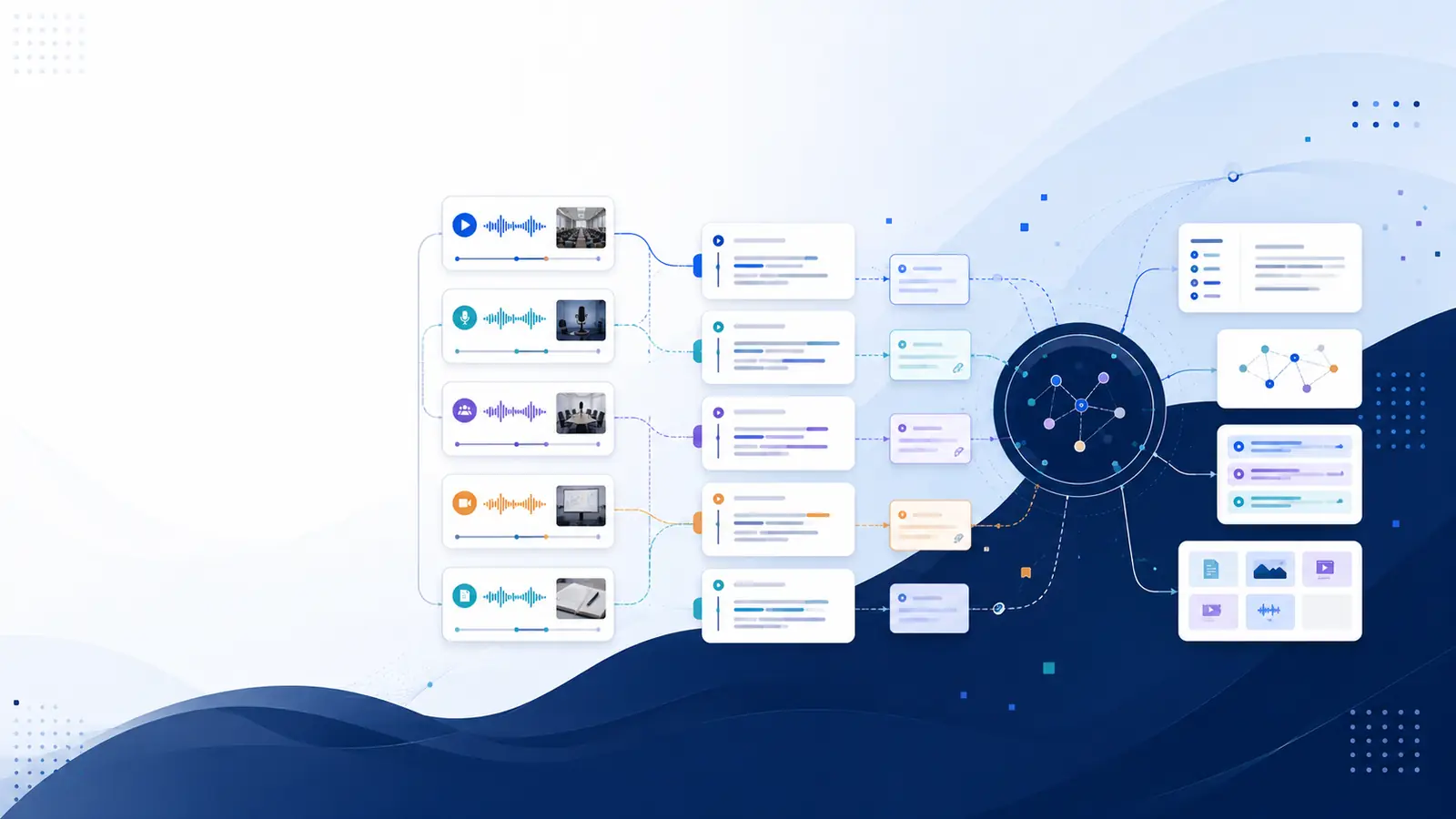
A searchable transcript turns spoken content into structured, usable information.
Instead of just text, it includes:
Timestamps linked to spoken sentences
Speaker labels showing who spoke when
A searchable timeline
Exportable formats for reuse
With searchable transcripts, you don’t “review” content.
You locate it.
Search a keyword.
Click the result.
Jump to the exact moment.
That’s the shift.
How Searchable Transcripts Replace Notes
Searchable transcripts solve what notes can’t.
Instead of writing summaries, you get:
The full conversation preserved
Context intact
Exact references available anytime
Instead of guessing where something was discussed, you know precisely.
This changes behavior:
Students revise faster
Professionals find decisions instantly
Creators reuse content efficiently
Notes become optional.
Search becomes essential.
Real-World Impact Across Different Users
Students
Long lectures no longer require full rewatching. Students can search topics, jump to explanations, and study more efficiently.
Professionals
Meeting recordings turn into documentation. Decisions, action points, and discussions are easy to trace later.
Educators & Creators
Content becomes reusable. One video can support blogs, subtitles, notes, and learning material without repeated effort.
Why This Matters More in 2026
Content volume is exploding.
Time is shrinking.
The ability to find information quickly is now more valuable than consuming more content.
In this environment, searchable transcripts are not a convenience — they are a necessity.
How Libraryminds Supports This Shift
Libraryminds is designed around one idea:
You shouldn’t need to rewatch videos to understand them.
With Libraryminds, users can:
Upload audio or video recordings
Get timestamped transcripts
Search inside content
Jump to exact moments
Download text or subtitle formats
The goal is not more content.
The goal is faster understanding.
Final Thoughts
Note-taking made sense when learning was text-based.
But in a video-first world, searching beats summarizing.
If you want to save time, reduce repetition, and work smarter with video content, searchable transcripts are the natural next step.
Try Libraryminds for free — upload once, understand everything.